Nobody wants to make a fool of themselves; it's pretty much a given for most of us. We do our best not to look like idiots or embarrass ourselves in front of others. When it comes to weight lifting, these thoughts, that people will laugh at us or look down on us, are at the root of a lot of beginner mistakes.
What do I mean by this? Well, the first and, by far, the most common mistake is EGO lifting.
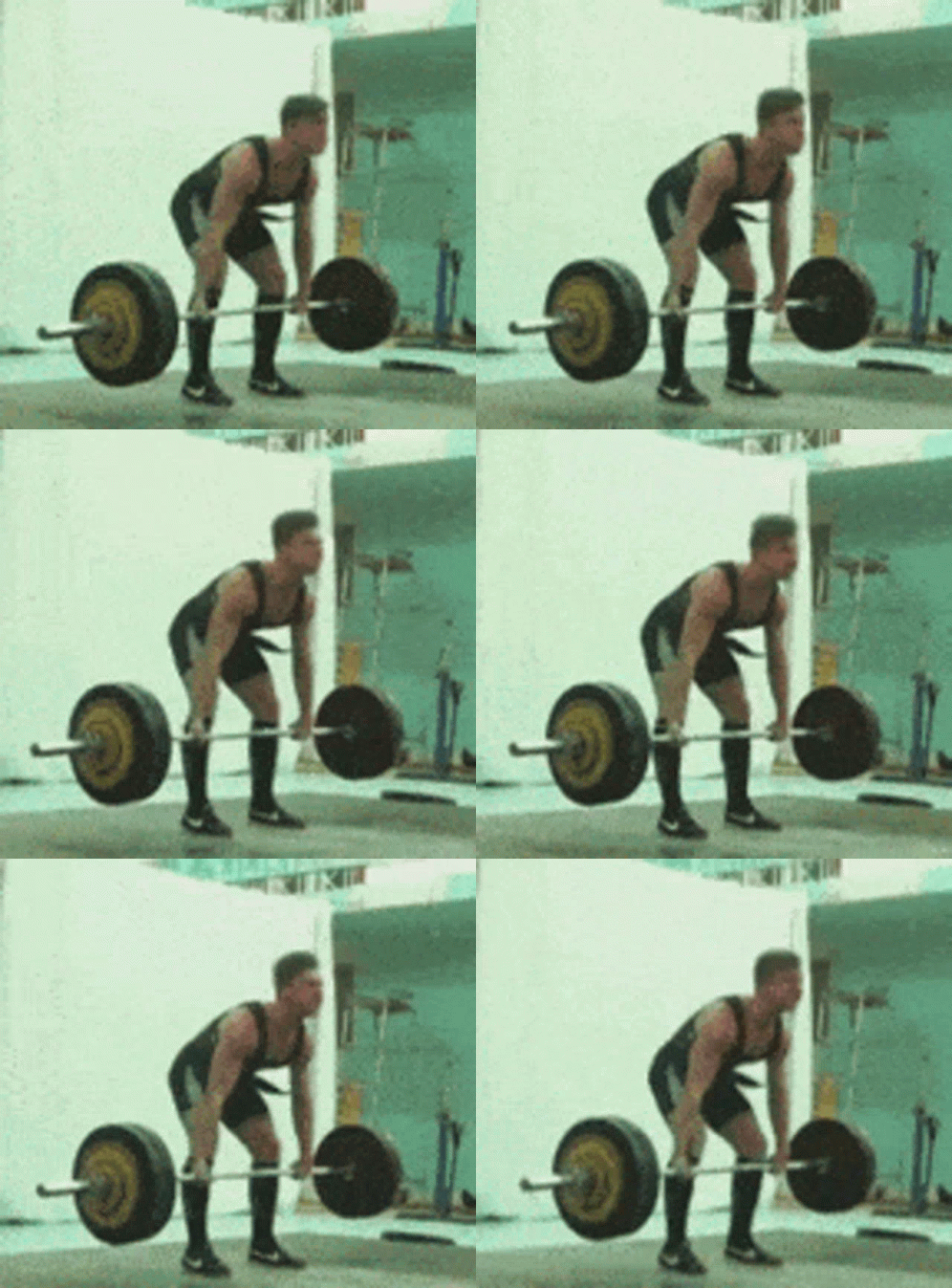
 That;s the reason why there are so many mirrors in the gym 😀 - you get to see yourself performing an exercise so that you can adjust immediately if you catch yourself slipping in terms of execution.
 Jokes aside, I hope you get the point; train your entire body for maximum results in the gym.
What do I mean by this? Well, the first and, by far, the most common mistake is EGO lifting.
Look, I get that sometimes you want to impress someone or just to look cool by doing an impresive lift.
Say you're a single guy, you are doing pull-ups and you see a lovely woman doing squats next to you. At this point, a thought may cross your mind, that if you do some weighted pull-ups, which you've never attempted before, chances are she'll notice you and you might start a conversation. Yeah ... chances are that it's not going to get you anywhere with that woman😊What is more likely is that you'll acquire a "lovely" injury - because you picked a weight that you can't handle and you, obviously, went for as many "reps" as possible (I put reps between quotes because let's face it, from a technique point of view, those are not 100% correct). If you really really want to give it a shot, smile and a simple "hi"/"hello", followed by politely introducing yourself, will most likely work better - you're welcome 😀
And no, going to the gym should not be about meeting women/men for romance; but hey, who the hell am I to judge you?!
Some people, maybe because they are shy or maybe because they are afraid of looking "weak", will overload their lifts because they think that they will embarrass themselves if they perform the exercise with a lighter weight. For example, someone who just started to lift a week ago and throws the 20 kg / 45 lb discs on the bar for incline bench press. Unless you are really strong to begin with, that's a lot of weight for a beginner.
The key point to remember is that ego lifting will almost always lead to bad technique which, in turn, will lead to an injury. Maybe you correctly execute the first 3 reps but, after that, things start to go downhill. There's also the case when you are just asking for an injury because you go soooo much overboard that you are going to get hurt the instant you attempt a rep.
I personally witnessed a very young man who overloaded the leg press A LOT! He probably had around 150 kg ... and he was just starting out in the gym. What happened next? The moment he started to bend his legs, the weight overwhelmed him and he ended up with his knees going past his ears. The failsafe of the leg press machine saved him; literally, it saved his life because he was stupid and wanted to impress ... someone, I guess.
The second most common mistake is bad technique. There's a reason why in my fitness posts I keep pointing out that technique is very important. It should be the very first thing you learn when attempting any exercise. In some cases, bad technique can lead to very serious injuries. As a person who's just starting out in the gym, remember that it's ALWAYS technique before weight! I can't stress this point enough. Learn to correctly perform an exercise BEFORE adding weight. If you learn the proper way of executing an exercise, you have the rest of your gym life to add weight; the other way always leads to injuries.
Let's look at the bench press. The correct way of setting up on the bench requires retracted shoulders, a slight curve in your lower back, thus bringing your chest forward, priming it for the press, proper grip position on the bar for your height, such that your elbows will have around a 60 degress angle, relative to your torso, when the bar is in its lowest position, having your feet firmly on the ground, keeping your core tight, thus providing stability and power for the lift. If you neglect the above, you run the risk of injuring your arm joints, your lower back (yeah, if things are loose down there, bad things may happen when bench pressing) and obviously, your pecs.
Please trust me on this - technique is crucial for your lifts!
The third most common mistake is focusing on a single muscle group. So many times I hear people saying stuff like "I wanna grow my chest" or "I wanna grow my biceps" and they start to train only those muscle groups. What you need to understand is that you will create massive imbalances by doing this. Also, by neglecting the rest of your body, you massively limit your growth. Our muscles generally work together. We can rarely isolate 100% a specific muscle group. Think about it, when you're benching, you engage pretty much all the muscles in your body, either by keeping the muscles contracted for the entire set (e.g. your core) or by actively being engaged in the press (pecs, shoulders, triceps). If you only focus on your pecs, you won't be able to progress much with your presses.
Every muscle in our body plays a specific role and, in general, "likes" to work together with other muscles. That's why it's important to work on all of the muscles groups; there's also people who skip leg day - these people are not be trusted 😂😂!
For forth place, we have a tie. Unrealistic expectations and not being consistent with your trainings.
Let's start with the first one. There's a lot of BS on the internet that can really lead people to some pretty crazy expectations. "I wanna add 40 lb of lean muscles mass in 3 months" or "I wanna lose 30 lb in 2 months" 😐😐.
Our bodies are highly adaptable and will literally change according to what we do in the gym. However, it won't happen overnight. Also, there's the genetics factor to consider. Some people put on muscle mass faster than others. Same goes for losing weight. Everybody is different so give yourself a realistic amount of time for the goals that you want to accomplish in the gym.
Also, you can't grow your muscles indefinetly. Myostatin is a protein that limits muscle growth - this is so that our muscles don't grow beyond a point that will endanger our tendons, ligaments or even our bones - imagine being 300 kg heavy and having only lean muscles. Sounds interesting right? Yeah, our joints and bones were not designed for this amount of weight! That's why we have this protein in our muscles that prevent them from overgrowing 😀
Not being consistent with your training regime can cause all sorts of problems. Some people do not train enough while other people overtrain. Both are bad. If you do not train enough, you will obviously not achieve your goals in the timeframe that you set. For some people it may make them quit the gym altogether when they've been "training" for an year and there are is so little in terms of results.
When it comes to overtraining, this can lead to injuries such as muscle tears, joint aches or more serious things like broken tendons, ligaments etc. Overtraining can have the opposite effect when it comes to muscle growth. Learn to achieve a balance in terms of trainings per week that works well for you. They key point here is to "listen" to your body and learn when it's ok to push a little harder or when you should take a day off; also, in the first couple of months you should nail down your general recovery time (be that 48 or 72 hours - there are some people that recover really fast, like 36 hours, but that's really rare).
The fifth and final thing I want to talk about is neglecting the importance of REST and NUTRITION!
Some people say that the gym workout is the easy part in reshaping your body; the hard part is having enough rest/sleep and eating appropriately for your goals! I tend to agree with those people. Rest and nutrition are as critical to you achieving your goals as is technique when performing an exercise.
You've probably heard the expression "abs are made in the kitchen"; that's 100% true. For maximal results, being disciplined outside of the gym is just as important as in the gym. Having enough quality sleep, eating clean, healthy foods and sticking to the targeted caloric intake requires a lot of dedication and focus, but trust me when I say that it is just as important as doing those lifts/pushes at the gym.
You've probably heard the expression "abs are made in the kitchen"; that's 100% true. For maximal results, being disciplined outside of the gym is just as important as in the gym. Having enough quality sleep, eating clean, healthy foods and sticking to the targeted caloric intake requires a lot of dedication and focus, but trust me when I say that it is just as important as doing those lifts/pushes at the gym.
As an analogy, you won't get an F1 engine to run on low quality fuel, and even if by some chance you get it started, it won't run at full power. That's exactly what rest and nutrition are - the fuel for your body to successfully accomplish the goals you set. So, next time you wanna party hard and hit the gym the next day ... might be a good idea to reconsider 😀
Comments
Post a Comment